Section 1: The Search in Empty Stacks
When’s the last time you went willingly into a library?
In days gone by, libraries were kingdoms of wonder. You went there to gather information for book reports or to enjoy a moment of calm before returning to the forward propulsion of the classroom. Today, they hold a paltry percentage of that value. The sense of discovery has been replaced by a visible, thinning austerity.
The Aliante Library smells like a stay of execution— that stagnant cocktail of pulp and industrial-grade lemon wax curated in every branch since the nineties. I went looking for Blood Music by Greg Bear, an obscure 1980s sci-fi horror title. I wanted the hardback, the one with a spine that cracks like a dry knuckle when you open it for the first time in a decade. Instead, I stared at a gap on the shelf where the B’s should be, a physical stutter in the alphabet.
The shelves are dieting; the rows have leaned out, leaving behind too much light and not enough weight.
"Looking for something specific?"
The clerk didn’t look up from her stack of returns. She wielded a date stamp with the rhythmic apathy of a bureaucrat.
"Do you have Greg Bear’s Blood Music?" I asked. "The hardcopy. Not the digital license."
She finally glanced at me, her eyes did a quick scan— likely looking for a certificate of proficiency to see if I was capable of using the self-checkout kiosk without a tutorial. Finding none, she turned to her monitor.
"We can have it here by Monday," she said, her voice a flat script. "Or you can check the Libby app. The audiobook is available now."
"I prefer the actual book."
She offered a slight, professional smile. To her, I was an interruption in the workflow, gumming up the efficiency of her fulfillment center.
I walked the aisles anyway, dragging my fingers across the remaining spines. The horror section was small. No blood-red lettering, no garish 80s paperbacks; only an alphabetized sterility remained. The gaps between the books create a clear view into the next aisle, where an older man types with two fingers at a public computer, his face illuminated by a government form. Nearby, a woman prints a dozen resumes. The library is still a temple, but the old gods have been toppled; we’ve traded the divine spark of discovery for the utility of survival.
Section 2: The American Desert of Third Spaces
When I was a kid, you didn’t need a guide to haul the weight of expectations into the stacks. I read the Hardy Boys, Ramona Quimby, and Goosebumps because I felt like it. I didn't look for an author’s last name; I looked for a mood (all vibes).
You headed toward the corner that smelled like woodsmoke and old book pages and let the covers speak to you. That’s it. There was no algorithm, just the physical magnetism of a matte-finish paperback with a raised-foil title.
Now, the library operates with the precision of a pharmacy. This layout rewards the "efficient seeker" but treats the "curious wanderer" like a loiterer. If you want Horror, you have to hunt for it through the B’s for Bear or the K’s for King, scattered like debris across a sterile landscape.
The irony is that the "living" library still exists in pockets. I found one at Shadow Ridge High School, where the shelves are still divided by feeling. Each section is decorated with genre-fitting signage: blood-red lettering for horror, surging pink for romance, and crumbled gold for mystery. You can browse with your sense of taste instead of metadata.
But in the adult world of 2025, the library has shifted to accommodate the "Fulfillment Center" model: they act like Amazon now. Additionally, library staff have become triage nurses for the homeless with nowhere else to go, their connection to the written word buried under the weight of social service. Digital licenses and "one-click" borrows are touted as accessibility, yet they feel like a slow eviction from the "third space"— that essential, non-transactional air where you are allowed to exist without purpose.
Section 3: The Bigger Problem
The struggle of libraries is a symptom of a country that has forgotten how to let its citizens simply exist.
In the United States, every square foot of public soil seems to demand a receipt. You can sit in a coffee shop only as long as your latte remains warm. You can stand in the post office only if you’re clutching a package. We have become a culture powered by the relentless pistons of an internal-combustion engine, burning through "purpose" to keep the wheels of the economy turning. If you aren't producing or consuming, you’re a clog in the machinery.
This is why the library, once a place of lounging and learning, has morphed roles over the years. It’s warped into a daycare, a cooling station during the scorching summer, and a digital unemployment office. The signal is clear: move along. The library isn't dying because we stopped reading. It’s dying because we’ve forgotten how to give people a place to be human without charging them for the privilege.
Section 4: The Descent into West Las Vegas
I headed south, toward the historic core of West Las Vegas. The Strip loomed just another 10 minutes away— a shimmering monument to the very transactions I was trying to escape— but the mountains stood ahead, jagged and indifferent.
The West Las Vegas Library is a deliberate "third space" that defies the "move along" signal of the Strip. Stepping through the doors, the vibe shift is physical. It smells of fresh paint and new books, intentionally designed as a community hub.
Before the book aisles, there is a gallery of local legends. West Las Vegas was once the only place Black performers like Sammy Davis Jr. could sleep after headlining the casinos that barred them from the front door. The gallery pays tribute to the neighborhood’s skeleton: activists, architects, and DJs.
"Look at this," my wife whispered, pointing to a portrait of a woman who spent forty years organizing literacy programs just blocks from where we stood. By grounding the building in the specific faces of its neighborhood, they’ve built a place that remembers who we are when passion meets people.
Section 5: The Creator Suite
Beyond the front desk, the floor plan feels ripe for exploration. I saw 3D printers available for anyone trained to use them, but the real surprise was the "Multimedia Room."
"Multimedia" is a high school term from the nineties. A better name (the one I gave it) is the "Creator Suite." It is a provocation to the outside world, stripping the tools of production of their gatekeepers and handing them to anyone with a library card.
A young heavy-set woman walked us through a functional music studio. The soundboard faders were multi-colored and glowing; soundproofing surrounded a digital drum set and an empty microphone stand. Then came the green screen room, a void of digital green and professional lighting. In 2025, with AI integrated into our editing suites, a room like this is a stage to take performers anywhere their imagination allowed.
Wonder, which had felt like an ungraspable sparling in a chilly river, suddenly returned. As a novelist, I felt a familiar pull in my hands to step into the booth and speak a new world into existence.
Section 6: Induciae
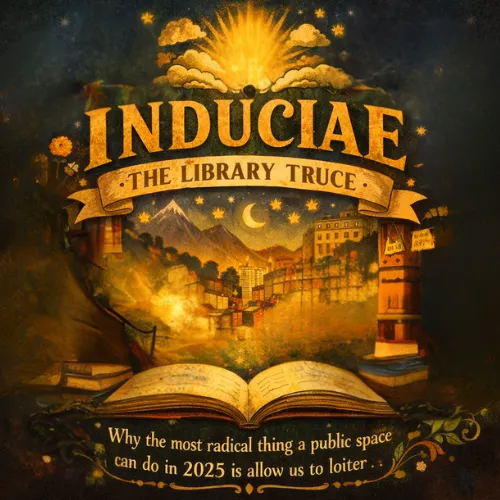
On the second floor, the library reveals its greatest gift: induciae. In ancient legal terms, it’s a truce— a temporary stay of hostilities. This space offers a ceasefire in the struggle for attention.
The view of the desert mountains at the horizon framed the room, but the life was in the seating. These nooks were meant for loitering or light work. In a study room, a woman sat with a Bible and a highlighter; she looked like she had been there for hours. Nearby, in a recessed lounge, a family was engaged with a board game, the children’s hushed arguments provided a rhythmic contrast to the library hush.
This was the "living" library. In West Las Vegas, the architecture gives you a nod of approval to just be. You don’t have to check out a book to "check in" to the community. You can simply sit and exist as a human being rather than a consumer.
Section 7: Finding My Place in the Story
I stood by the window, looking at the mountains, and felt a shift in my own narrative. If I want to record my next novel, the production booth is waiting. If I want to practice Japanese or record a podcast, there is a place for my voice.
"Is this the place?" a boy asked, tugging on the sleeve of a tall man with a beard like a thicket of gray wire.
"This is it," the man replied, his voice a low rumble of pride as he gestured toward the creator rooms. "This is where you make things."
The books I couldn't find in Aliante are secondary now. What matters is the empty chair in the sound booth, the glowing faders, and the quiet permission to stay.
The library raised me on stories, but this brand new place provides the tools to tell novel ones in new ways. I am no longer just a reader in a barren aisle; I am a builder in a new kingdom.