Video
Audio

Text
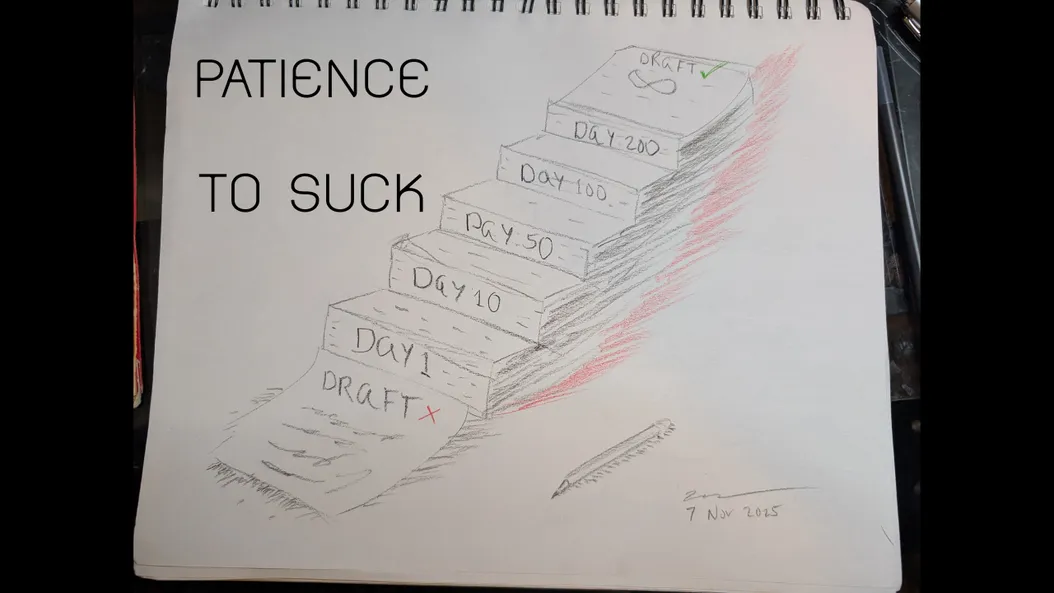
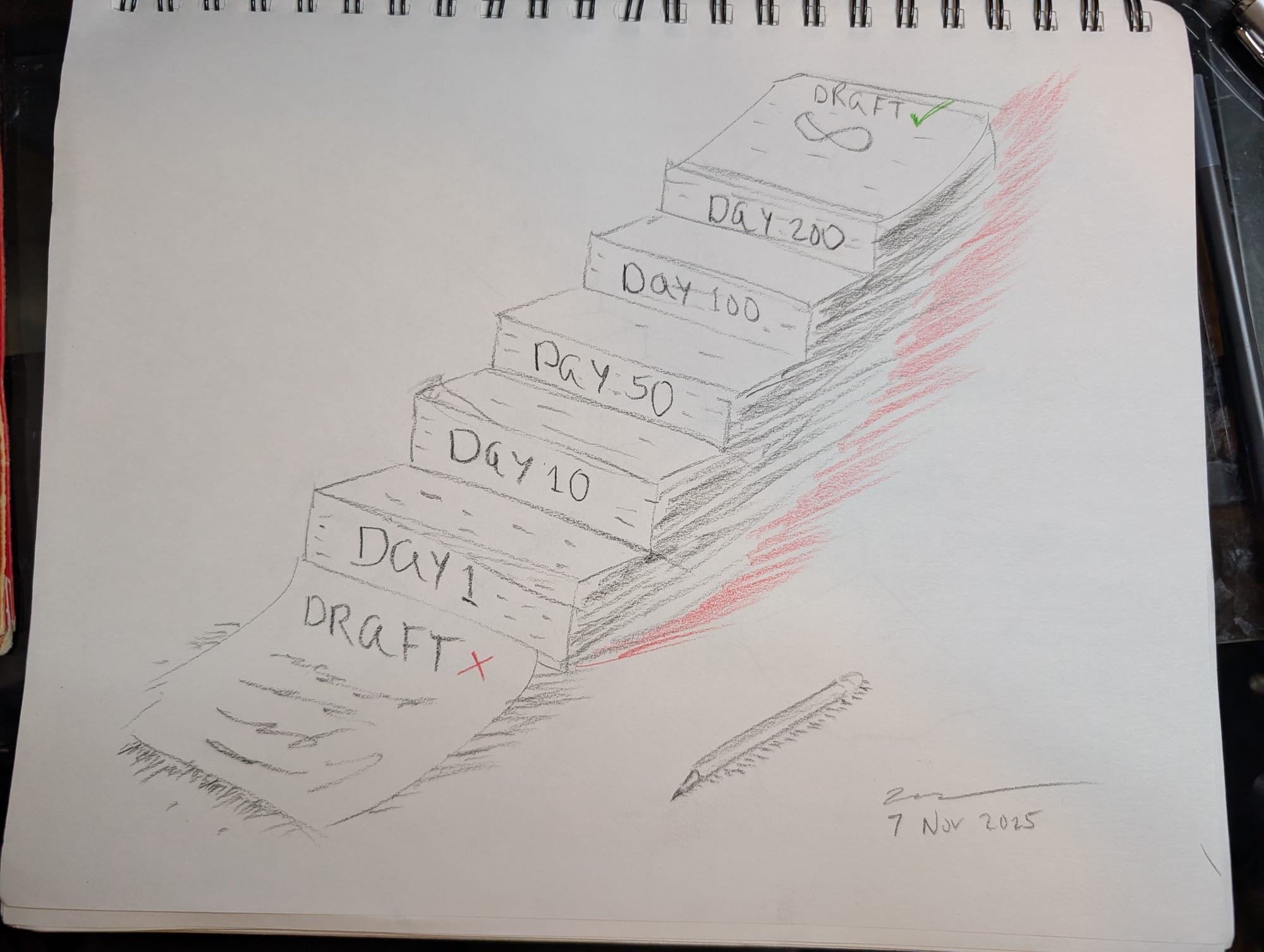
I’ve come to believe that mastery isn’t about talent or luck— it’s about the patience to suck long enough to get good. The hardest part isn’t learning the craft. It’s enduring your own mediocrity while you become someone capable of excellence.
When we’re kids, the world forgives our failures. We’re surrounded by peers who are learning right alongside us. But when we become adults, the world stops clapping for effort. We’re expected to be competent at everything, and that expectation kills experimentation. I’ve had to relearn how to fail in public without shame.
Learning to Keep Going Without Witnesses
When I was younger, I had structure— teachers, grades, mentors, progression. In adulthood, that net disappeared. All I had left was my own desire to learn and a world that didn’t care whether I did. And that’s where most people stop. They can’t stomach looking foolish without validation. They need applause to continue. I learned that true mastery begins when you keep going without witnesses.
Leaving the military forced me to face that truth. Nobody hired me to be a novelist, and nobody paid me to start writing books. I spent years writing, recording, and publishing in obscurity. But those years became a kind of crucible— proof of conviction.
I asked myself the question that became my north star:
Do you have the patience to suck long enough to get good?
Most people don’t. They tell themselves stories— about time, about the world being too unstable, about AI taking over, about not having the support they need. What they really mean is: I can’t handle being unseen while I’m bad.
Life as a Long-Form Game
During the pandemic in 2020, I reframed my whole philosophy. I started seeing every skill— writing, language learning, music, AI— as its own video game. Each had its own controls, rules, bosses, and progression system. And I realized: if I can master digital worlds, I can master real ones too.
Failure became the early level of mastery, stripped of the visual reward. In games, you get LEVEL UP! screens and victory sound effects. In life, progress is invisible. The hit feedback is subtle— you notice less friction, better flow, cleaner outcomes. I started viewing creative growth like a long-form RPG: die, respawn, retry.
My Secret Ambition
I rarely say this out loud, but my secret ambition is to be a modern-day Da Vinci. Da Vinci had his notebooks; I have novels. He drew and theorized across disciplines. I write, draw, compose, build apps, and explore the interface between humanity and technology.
It’s not about being smart. It’s about emotional discipline— the skill of being honest with yourself. I’ve learned to identify when something isn’t working, to adapt quickly, to learn the next necessary skill without shame. I self-audit constantly. It’s not fun, but it’s always.
The Rebellion Against Mediocrity
When I was a kid, I looked around and saw adults who had stopped trying. Sitcom fathers like Homer Simpson and Al Bundy were the cultural mascots of stagnation— men who settled for smallness. Even as a child, I could feel the resignation radiating from that generation. I wanted no part of it.
My rebellion wasn’t against authority. It was against sedation. I refused to coast. I wanted to see how far I could go— how much of my curiosity I could turn into real skill, real stories, real worlds and impact. I wanted to prove that adulthood doesn’t have to mean slowing down.
My Current Boss Fight: Showing Up In Person
Right now, my hardest challenge isn’t writing— it’s showing up. After years of building a digital fortress, I’m stepping out into the real world again: book festivals, writing groups, indie bookstores, author conventions. It takes more energy, more money, more vulnerability. It’s a three-headed dragon: business, outreach, and self-management.
But I’m learning that impact doesn’t come from hiding. It comes from embodiment. I’ve structured my days with boundaries, worked on my time management, and found a rhythm that lets me push without burning out. I call this phase full-contact creativity— where the art meets the world face to face. There's nowhere to hide.
Why I Still Believe
My novels are my living philosophy. They’re how I prove what I believe about humanity: that this is still a great time to be alive. That technology doesn’t erase the soul— it reveals it. Every book I write is a new experiment in emotional resilience.
If Da Vinci had notebooks, I have stories. That’s my legacy. Not fame, not validation— proof of evolution.
I bet my life on my potential. And I’m still winning.
Artwork
Music - "When the Saints Go Flubbing In"
Performed by Keith Hayden