
The shortest commute of my life was a three-minute walk across the street in dry warming sun. Even with a brief conversation with the grandmotherly crossing guard— neon green vest, matching gloves, new hat she wanted to talk about— the whole crossing took under ten minutes. I have lived across the street from Goynes Elementary for years. From afar, this was a coveted sub assigned, mostly for its proximity from home. But I was also always curious about what it was like in the school across the way. And there I was, finally, walking through a door I'd only ever looked at passing by while on a run.
Inside, everything miniaturizes. Chairs, counters, desks all shrunken for smaller hands and feet. I always feel giant when I walk in an elementary school. The day's assignment was music class. I tweaked my ears to prepare for noise. Harry Potter has had a heavy influence here. The classes are divided into six houses with names too awesome to have been decided by a school board. Presentation of the crests and names on a massive wall-spanning Lego plate, using the ultimate childhood building toy similarly stood out. So much so I surreptitiously snapped two pictures of it.
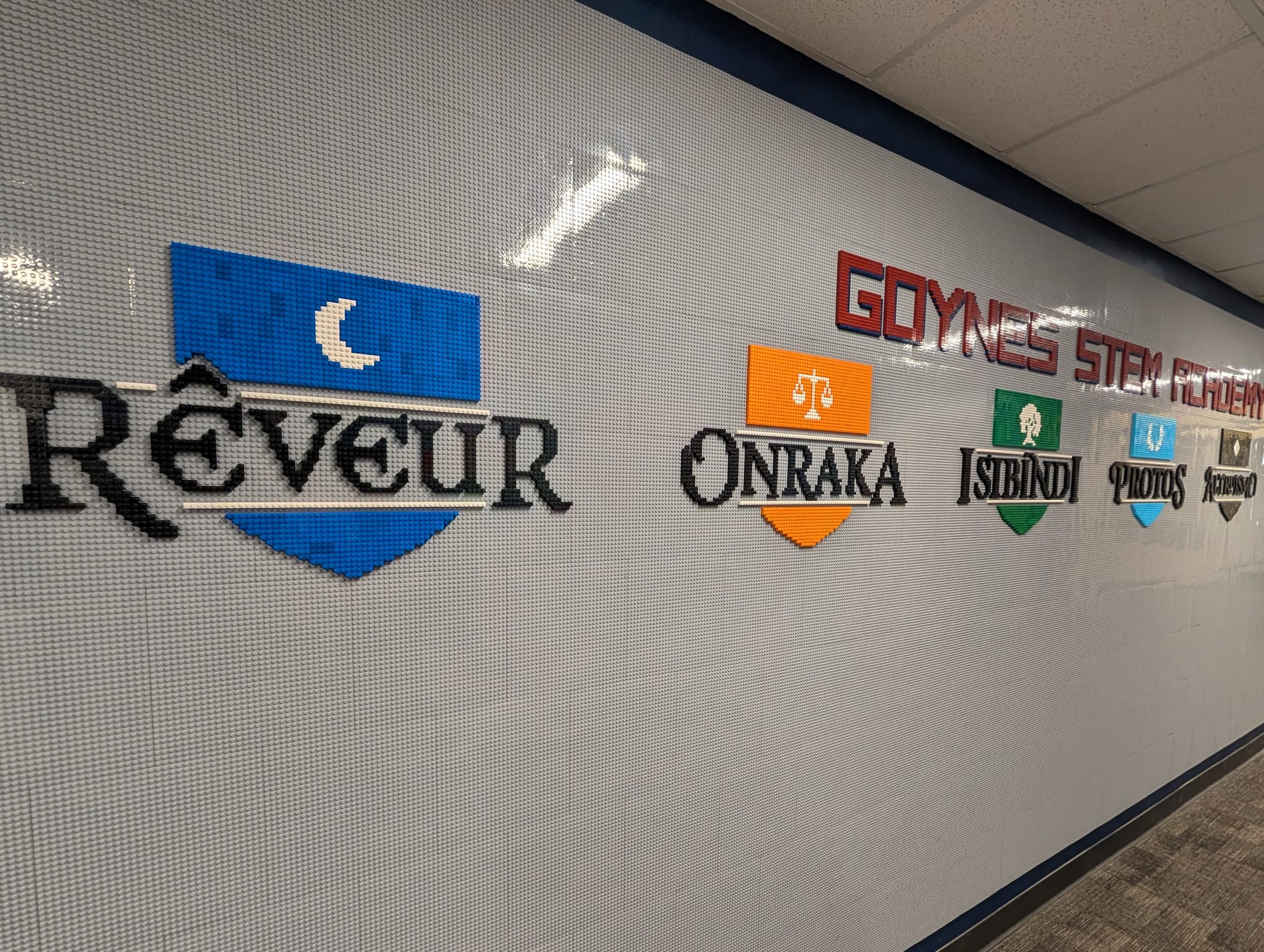
The houses on the wall were named in French and Greek and other languages I half-remember from books— Rêveur, the dreamers, blue and unicorn-coded, the house I would have wanted if I'd been small enough. The fact that I had been reading Proust the day before made rêveur feel like a cosmic joke.
Then the first period happened, and the joke turned.
Sometimes in life, one small decision becomes a big mistake in a half-second. Mine was allowing the students to play games. The teacher's note said "slides or games" and the slides had videos I didn't know how to get the sound working, so games it was.
Now this was fourth grade, end of school year mode “on”, stranger in the room, so you know they were gonna act up. At least I knew they would. And within ten minutes, it was Lord of the Flies: Music Room: kids on xylophones, those annoying cymbals, little instruments that go clic-clack I hadn’t seen since I was young. Small board game pieces dotted the floor as stepping spikes around the splayed out bodies of those drawing or playing quietly while, several ran figure-eights through the hazards. Four students banged out discord on a keyboard, taking turns stabbing at the keys while I searched for a way to turn down the volume.
Then the lights went out.
A small sandy-haired kid materialized at my elbow. “It's a lockdown drill,” he told me, “we have to go into the corner and pull down the thing. Can I do it?” The thing turned out to be a Vegas Knights cover over the small vertical window in the door. I approved him to go over to do it, but at my back the screams and shouts were coming abrasively loud at my ears. When another teacher, then a few minutes later, the principal Herself, showed up I knew I’d fucked up.
The room had been too loud for me to hear the announcement.
That’s the whole substitute teaching problem in one line. You are the adult legally responsible for the room, yet you are also the adult least equipped with the room's history. Extremely localized geworfenheit hits hard. Without knowledge of student temperament, dynamics, or informal school protocols, you’re cooked.
“We’re cooked,” is exactly what one boy said as the principal glared at us from the door. With one permissive call, a kid is doubled over because some girl kicked him in the nuts and said it was an accident, and later that afternoon another teacher will appear at the door asking for your side of the story because the father has shown up at the school, and you will hear yourself say, “I'm a terrible witness here because I've only got one touchpoint with this incident.” That's what lay behind door number one.
Door number two held a different version of the dream. This was a much calmer second grade class. In it, a Black girl that had been talking to me off and on all class accidentally hurt a girl named Sky's feelings. It one of those instant childhood reversals, one second they're sharing colored geometric pieces while forming flowers on the carpet, the next is a call to tears. I sent her over to apologize. So she walked on her knees over to the other side of the room to try. But Sky wasn't having it. She looked back at me with a small shrug that meant I tried. From across the room through gestures, I told her to keep doing it. Five minutes later they were playing together again. I'm not a parent, but that little scene almost made me choke up, and I couldn't tell you exactly why except that it was the cleanest version of a lesson many adults struggle with: intention does not erase impact, and the repair has to be made by the person who caused the wound. If you cause a mess, you should clean it up.
All in all I spent six hours in the long hallway of the school. Despite only being three minutes from my house, I came home wrung out in a way that six hours of work at my computer can’t compare with.
Kids don't tire you with their time. They wear you down with density of need— the per-minute load of micro-requests, constant translation of imprecise language into actionable response, and the micro-tax of staying inside a room where bodies are unpredictable and the consequences are real, drains you drop by drop.
Every quarter I earn a burger. My favorite is the double patty bacon and guacamole burger from Carl’s Jr. While I was waiting for my order the day's second hallway opened up.
The third door opened to a more philosophical scene. I had the thought that everyone should have a business.
What comes to mind when you think of business? Maybe it’s inventory, payroll, or marketing. But what many miss is that running a business doesn’t need to be hustling for eighty hours a week, cranking out daily content, or hustling like Alex Hormozi or Gary Vee. It can just be a small legal container for the part of you that might one day make an offer to the world.
The number one question I get from students of any age is do you have kids? (a second-grader asked me that today). I know why they do it. It’s because even children understand intuitively that kids are continuity, biological and social; they are a living extension of yourself into the world. Plus they wonder— if they like you— if there is someone their size and age who shares your qualities. The unspoken thought is: “This guy’s cool. His kids are probably cool too. Maybe I could meet them someday.” It’s a child’s way of connecting their experience to yours.
Sitting there at Carl’s Jr. I had the thought: why don't we ask do you have a business?
I think we should.
Not because everyone needs to monetize their hobbies, but because a small business is self-granted permission. It says: this thing that I like is not pretend and is a named place where my interests are allowed to become offerings if they want to.
I say this now because AI has collapsed almost every old barrier to creating and maintaining most professional business infrastructure. Your website, app, copy, and brand material — all of it is one-shottable now. What took me five years to organically discover and create can be done (with higher quality) in a day.
What's left is the question of whether you've claimed the legal and psychological ground to stand on for what you offer. You can give yourself permission to show up with your innate talent or evidence from your personal explorations anytime and in anyway you want.
There’s no need to join the internet AI hustle grind. By just having your business exist in the background makes your life more colorful and alive, it gives you a contained place to publish and produce outputs that, in time, could lead to greater financial gain and happiness than you could ever achieve inside established incentive hierarchy.
That's the same instinct as the corpus, which is the same instinct as walking three minutes across the street to a school I'd never set foot in, just to see what was on the other side of a door I'd been looking at for years.
Close the door on your way out.
—
By the evening, I opened the final door but there wasn't anything to see.
I was thinking about my corpus again. It’s a personal-archive system I'm building so I can more easily train AI models on what Keith Hayden sounds like instead of guessing. I'd decided to test it: pick a year at random and find a physical artifact from it. I picked 1986.
I scanned my desk for anything from that era. The oldest thing in reach was a California Raisin doll my brothers and I got on one of our first trips to Vegas, but that was off by five years. I tried the photo album my mom made me— pre-K picture, '88. It was closer but still off. By the time I'd worked through the chain I had to admit it: there is nothing from 1986 in my house. Not in a desk, drawer, or anywhere in my mind.
The archive of that year exists, but not in any accessible form.
That thought hit harder than I expected. A second blow clapped my psyche afterward: the whole reason I document my life so heavily is so the present doesn't poof out of existence so easily. And there I was staring at a walled up frame I couldn't walk back into.
This is my definition of negative space. A gap in time or place where you can see the shape of something only because the thing itself has been removed.
1986 is not an abandoned building. It is the memory of a building after the building is gone.
I was there. I had a body and a name, a sick spell and a brother and a mother taking care of me. And I never will be there again.
A body-felt fear made its presence known to me after examining the negative space of the year 1986.
I define fear of foreclosure as the moment something flips from "maybe" to "never." The permanent sealing off of options is scary.
That's why I do random-selection rituals. As a kid I used to lay out ten Super Nintendo (SNES) games and eliminate them one by one until I was stuck with the one I had to play. To this day I still do this with YouTube videos. The point was never the choice. The point was the visible array of doors. Closing the doors deliberately was better than hearing them slam shut as if they were in some drafty haunted house. The possibilities must feel endless or that constricted fear of being shut out of my own life returns.
One of my favorite songs is from the 2009 video game Sonic Unleashed. I still love the chorus:
I see it, I see it, it's all within my reach
I see it, I see it now, it’s always been inside of me
(and now I feel so free)
Endless possibility
These lyrics are a life orientation. I feel better when doors are always visible even if there's a hard wall or nothing behind them.
1986 is a disappeared door. A bricked up outline of a former threshold I see the outline of, but can never re-enter.