
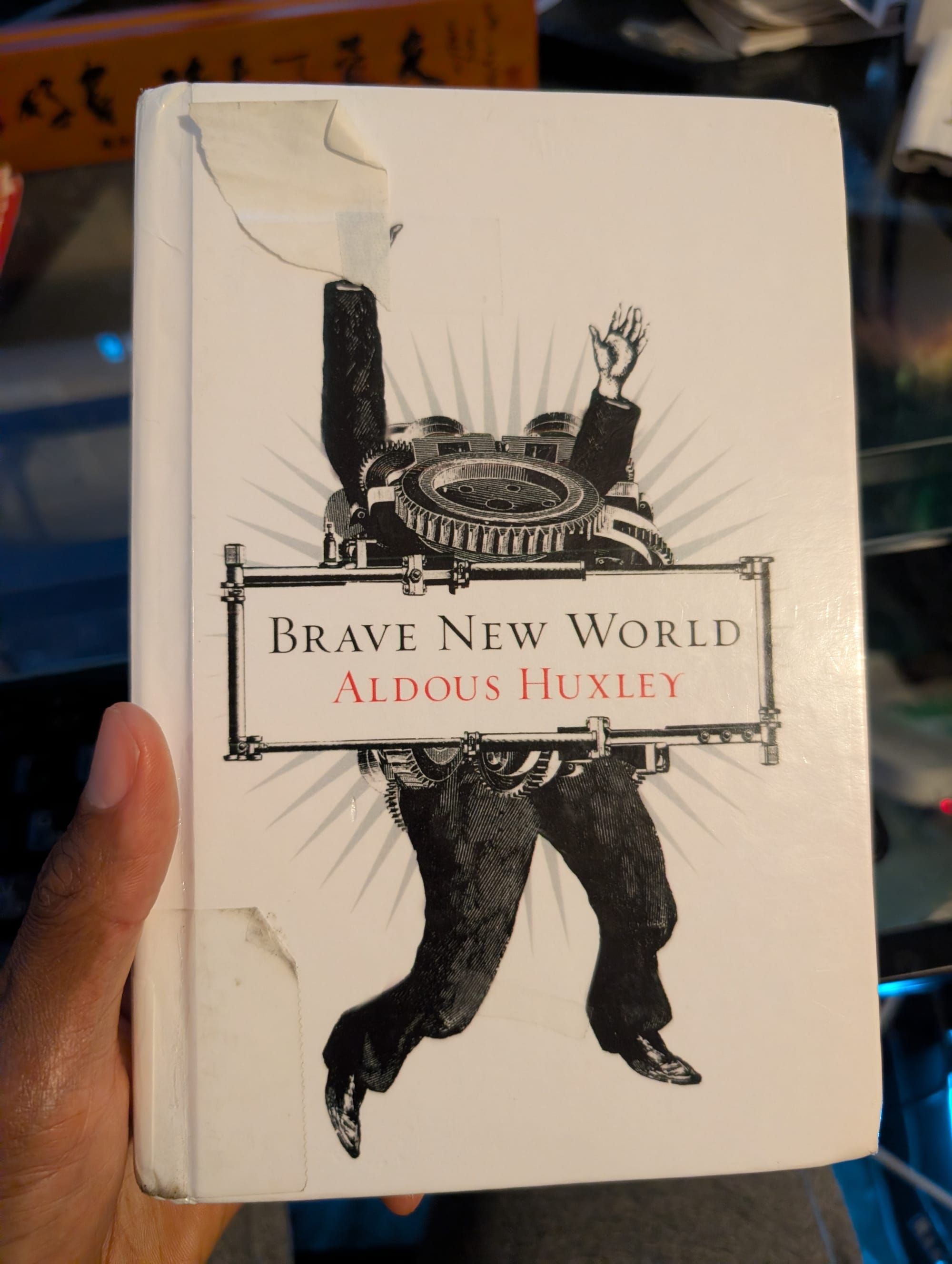
I just finished rereading Brave New World, and yeah, I see why it has earned its reputation.
This is one of those books I read when I was younger, probably too quickly, because I had way too much summer reading during AP English Literature in high school.
I read it because it was assigned and I had to be ready to discuss it early in the school year. But now I can go back to books like this as a writer, not just as a student rushing to the next read.
That has become one of the things I want to do more often: revisit the books I read as a kid or in high school and see what they actually are now. To see what was special about them, and what I can learn from them for my own writing.
With Brave New World, there's a lot I took from it.
It's a strange book, though. Good, definitely. Important, obviously. But not necessarily fun. Not in the way 1984 is fun to read, even though that is also a dark book. 1984 has the secret love affair, the danger, suspense, betrayal, and the dramatic setups and payoffs. Brave New World is different. It's more half social satire and philosophical debate with characters that mostly serve to puppet Huxley's points about his exaggerated vision of society.
I also like learning about authors, and the library copy I read had a short biography of Aldous Huxley in the back. I wasn't surprised to learn that he came from this academic, literary, high-pedigree world. It reminded me a little of reading about David Foster Wallace, who was also the son of an academic. Huxley wanted to be a doctor, but had eye problems, and then of course he had literary connections which gave his work instant credibility, audience, and status.
I always notice that because I think about myself, coming to writing with basically zero literary connections. I'm doing this from scratch in a different century with the advantage of digital technology and AI, so I can't be too envious.
However, that doesn't detract from the Huxley's hauntingly prescient view of society.
The Spectacle of Suffering
I want to talk about John's fate at the end, because it's is tragic.
Civilization forces him to kill himself because he feels he can't survive the pressures against his humanity. He makes the choice to leave instead of continuing on. The reason he leaves feels prescient today.
A smarmy feely director surreptitiously films him from the forest. He captures John's cleansing ritual and turns it into content. Huxley clearly has disdain for this exploitative journalist class. This single act by an unethical director ultimately causes John to kill himself. That feels so internet-native. Huxley conceives this 60 years before the commercial internet existed. Today, this is the normal status quo in 2026. Civilization doesn't merely reject John; it digests him. His pain becomes content.
The director is just a man with a camera, access, opportunism, and no reverence. This represents a decentralized, everyday form of exploitation. He sees something intense and thinks it will sell. The lighthouse sequence accidentally predicts the influencer age, true crime voyeurism, and trauma-as-content before the machinery exists.
John tries to recover moral agency through suffering and physical labor. The world finds him and turns that effort into a consumable image. Once that happens, his last refuge is gone. The system doesn't need to physically imprison him because it follows him symbolically. The tragedy is that the world becomes so efficient at eliminating inwardness that no private self remains for him. The horror of the book isn't just government control. It asks what happens if the crowd learns to experience another person's anguish as entertainment.
Craft Lessons: The Power of Compression
I notice another line that speaks to the age of AI. After Darwin Bonaparte gets the footage of John, the book states: twelve days later, the film comes out. That is quite a line. Huxley does worldbuilding the way I do it sometimes. He drops unexplained lines that say a lot about how the world organizes itself. This compression is one of the novel's most impressive feats. I tend to write long, so I definitely take this lesson on how to present ideas succinctly.
That "twelve days later" detail implies an entire pipeline. The footage is processed, edited, and consumed, and the public already knows how to respond. In Huxley's time, twelve days reads as grotesque speed. Now it almost reads as slow. Today, people remix and monetize John's whipping ritual before the day ends. Huxley doesn't explain the machine. He just shows the output cadence. A weaker writer explains the advanced entertainment industry. Huxley instead gives the actual felt fact. This one detail carries plot information, world information, moral information, and emotional pressure. His society moves at the speed of production, while John's interior life moves at the speed of spiritual crisis. I need to train this exact muscle. I want to make each line carry more voltage.
An Analog Future
Even though BNW is considered a classic it's not without flaws.
The worldbuilding feels very analog for a far-future utopia. Everything relies on pneumatics and helicopter screws. It feels like a steampunk vision. It roots itself in 19th and early 20th-century machinery (think early Industrial Revolution) which makes sense— this was the world that raised Huxley. I know flight is new when he writes this in the late 1920s. I'm not trying to disparage a hundred-year-old book. But I have to keep reminding myself this story supposedly takes place centuries in the future. It just feels like a discontinuity to me. The far future sometimes just feels like the 1930s. It feels like a nightmare about Fordism, mass media, and consumerism. The World State isn't technologically accurate, but it is spiritually accurate. The helicopters feel quaint, but the soma, sexual conditioning, and emotional flattening feel current.
The Argument Overtakes the Narrative
Additionally, the story itself isn't very good. Some early critics point out that the novel just dresses his essays in a story's clothing. I see that. My brother writes like this sometimes, and I do too.
You feel passionate about an idea, but the point you try to make overtakes the narrative. Towards the end, the book becomes an essay on society and religion. After Lenina throws herself at John to have sex with her and he violently rejects her, she disappears from the story for the most part. The first half focuses heavily on her vapid social life and Bernard's internal insecurities. Then they vanish from the plot. Bernard and Helmholtz find common ground with John, and we get one throwaway line confirming their friendship before they exit the stage.
I don't think this is deliberate. Huxley simply has ideas about society and mysticism, and the story becomes the vehicle. The novel is very light on narrative compared to 1984. Orwell fuses his ideas to suspense. Winston has a dramatic engine with his secret life and rebellion. Brave New World lacks that cinematic drive because the society already wins before the book begins. It reads like a soap opera in the beginning and an academic lecture at the end. It isn't very fun to read. The characters serve the argument more than the argument serves the characters.
Privilege and the Aristocratic Vantage Point
The class vision bakes directly into the worldbuilding. It shows Huxley's Victorian and erudite upbringing. One critic asks why Huxley writes a fantasy about a far-future sex-and-drugs utopia instead of addressing real-world problems. That criticism has teeth. Huxley writes from a privileged class. We see this archetype throughout history. An academic sits back and avoids physical participation in history, but he has a lot to say about it. David Foster Wallace fits this mold too. They fulfill their roles as academics rather than soldiers or politicians, but they maintain a detached position. Huxley mourns the loss of high culture from an aristocratic vantage point. His horror is often the horror of a highly educated man who watches the masses gain modern comforts.
A Felt Need for Increased Efficiency
Finally, my library copy includes a letter Huxley writes to George Orwell. I also discover Huxley writes a thematic sequel called Island. It explores the light side of utopia, and I might check it out. In the letter to Orwell, the older Huxley disagrees with the vision of 1984. He believes the future aligns closer to Brave New World. He writes that the nightmare of 1984 modulates into his own imagined world due to a felt need for increased efficiency.
That line strikes me. We essentially live in this right now. We all feel the need for increased efficiency every day. We feel the need to do more and to always broadcast. If you feel bad or lonely, a remedy exists. Now we have AI to mentally bolster us. Huxley's model feels current because the pressure arrives with the mask of convenience and optimization. AI fits uncomfortably well into this logic. It removes the unproductive wandering. 1984 gives us the nightmare of coercion, but Brave New World gives us the nightmare of accommodation. People comply because the alternative is uncomfortable or inefficient. Both men are right, but in affluent consumer societies, Huxley's softer control through appetite and distraction feels more accurate. The novel asks a crucial question. What parts of being human are we willing to make less painful, and at what point does that pain removal become soul removal? That question feels sharper than ever today relevant today than ever.