
Video
Audio
Text
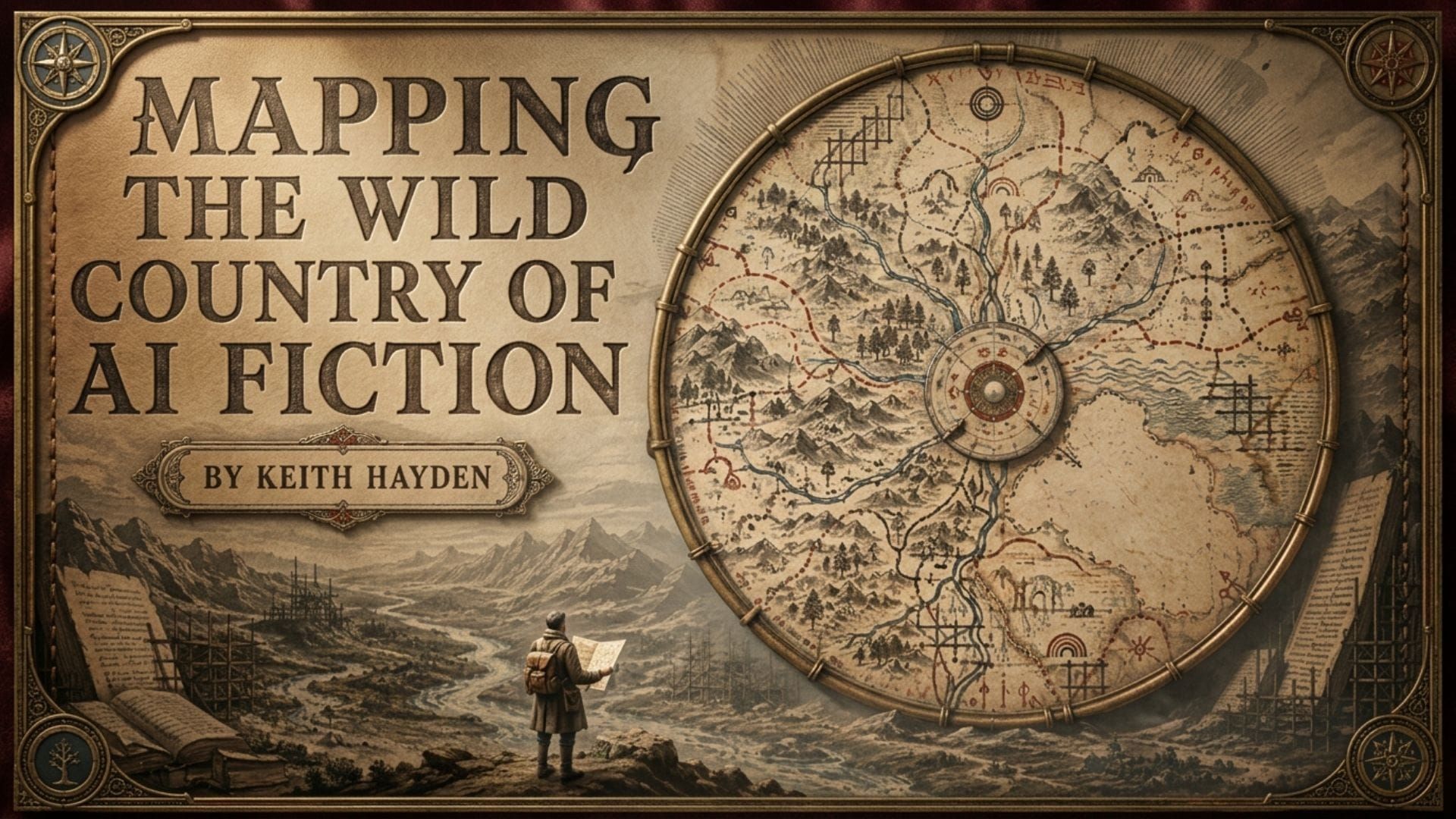
Generative AI still feels like wild country because our maps remain crude, even though people have already traveled surprisingly far into the territory.
We describe almost everything happening there as “AI writing,” a phrase broad enough to include a writer publishing the result of a single prompt, a fiction writer brainstorming a character, a writer asking for criticism of a plot, or someone generating fifty thousand words and eventually throwing forty-nine thousand away.
Those activities share a tool, but they don’t share a method, purpose, or meaningful definition of authorship.
I’ve spent several years exploring one narrow region of that country: long-form fiction. I’ve generated entire stories, rewritten books that began with AI, preserved small fragments, discarded enormous sections, and occasionally kept far more than I should have. During that time, I thought I was conducting a series of experiments in acceleration, attempting to discover how much faster AI could move me from an idea to a finished book. Productivity was the name of the game. Only recently did I recognize that the generated prose had been performing another function all along.
I call that function generation as "narrative prototyping": using AI to produce a provisional long-form fiction-shaped object whose value lies in what it allows the writer to see, even when most of its language never reaches production. I came up with the term this morning, but the practice behind it developed across years and several books, each one marking another point on the route toward understanding what disposable words could actually do.
A Third Route Through the Country
The default story about generative AI is a story about speed. These tools promise efficiency and a shorter distance between intention and result. The implied promise is the difference between an e-bike and a pedal bike: go farther, faster, with less hassle. This creates an easy comparison between two kinds of journey. A writer can rough it and walk toward a distant destination, discovering the landscape one exhausting mile at a time, or use AI like a plane ticket and arrive at a completed manuscript as quickly as possible.
There’s legitimacy in the walk because difficulty is part of the experience. Writing a novel from scratch means entering a landscape where the final shape may remain hidden for months or years, and the knowledge produced during that journey often becomes inseparable from the book itself. The journey is the destination, so to speak. The direct flight offers another experience, one centered on arrival. Convenient progression is the rule. In modern discussions of AI, the walk and the direct flight have become the default framing options. However, neither option quite described what I’d begun doing in my own fiction.
Narrative prototyping suggests a third route, something closer to flying over the country long enough to see one possible arrangement of its rivers, mountains, roads, and dead ends before plunging back to the ground with a rough map in hand. You can follow the map, redraw it, tear it apart, or freestyle your way into territory it never included. You may still walk nearly every mile yourself. The flight’s value comes from making the larger landscape visible before you commit years to crossing it.
It took me four projects to understand that distinction, and each one changed the question I thought I was asking.
Shadowbanned: Counting What Survived
In 2023, when I made my first serious attempt to write an entire story with generative AI, my process had the simple clarity of an assembly line. I would generate a chunk, move through it sentence by sentence, keep one line, change the next, rewrite another, discard whatever I couldn’t use, and then generate the next section and begin the cycle again.
The calculation underneath that labor remained straightforward: How much of this can I use in the final story? It was all about efficiency: writing faster and getting a publishable work to market. Every generated sentence that survived represented a sentence I hadn’t written from scratch, so the experiment succeeded according to how much usable prose the machine contributed.
That model turned revision into a salvage operation. The generated paragraph was a pile of parts, and my job was to determine which pieces were sound enough to install in the final story. Generated sentences that were discarded were wasted output because I hadn’t considered that the pile itself might reveal something useful, or that the knowledge produced while rejecting the scraps could matter more than the words I kept.
Sync Whole: Overused AI
By the time I wrote the novella Sync Whole, I’d moved beyond wanting AI to write the entire piece for me. Shadowbanned had been an experiment in writing an entire novella with AI, but Sync Whole was part of my established Cereus & Limnic series. There would be no freestyling or letting the model invent whatever story it wanted. The book had to work within an established world, with established characters, and fit the series’ existing continuity. This made the process feel more deliberate than the one I’d used for Shadowbanned. I rewrote the manuscript significantly.
When I returned to Sync Whole some time after completing it, I could feel how much AI remained in the manuscript, and I didn’t like it. The problem wasn’t that every generated sentence was obviously terrible, because a great deal of AI writing is competent enough to escape immediate deletion. Sentence by sentence, the material can pass an editorial inspection. However, accumulated across a story, it creates a texture that’s unbelievable to both the writer and the reader. It’s clunky. It’s offensively bland. And worst of all, it’s boring.
Sync Whole taught me that substantial revision didn’t guarantee I’d taken full possession of the story. I could change a great deal while preserving too much of the generated rhythm underneath, especially if I continued judging the experiment according to how efficiently I could convert its output into something publishable. I’d become more capable of directing the models, yet I was still asking how much of their language could stay. It began to feel like I was asking the models for permission to use my own imagination, and that wasn’t a good place to end up.
That discomfort followed me into the next project, where circumstances pushed the experiment far beyond the scale of a novella.
Gates of Okinawa: The Novel I Finished Twice
Gates of Okinawa began in May 2024 with a ridiculous plan: I was going to write a James Patterson-esque novel in approximately a month. That same summer, I was preparing to move back to the United States. Speed was embedded in the project from the beginning, and generative AI made the ambition seem plausible because I could keep producing the story while preparing for the move.
By July, thanks to generative AI, I had a finished novel. We returned to the United States in August, but I didn’t publish the book until November because I spent the next three or four months rewriting the entire fucking thing.
The second time through the manuscript changed the meaning of the first one. The AI-heavy draft had carried me to the end of the plot, established a sequence of scenes, and given me enough to see what I was making. It still wasn’t enough to bring the novel up to my publishing standards. I’d reached an overlook from which the route became visible, and from there I ventured back through the uncharted wilderness on foot, rewriting until the story met those standards.
That process produced the first balance that felt right. AI remained heavily involved in the initial version of Gates of Okinawa, yet the published novel didn’t read like generated fiction. It read as human-crafted, which ultimately it was. The AI draft gave me a foundation to stand on, and I no longer needed to justify it through the survival of its generated words. It had already earned its place by giving me a structure I could inhabit and transform.
At the time, I interpreted this as an unusually aggressive revision process. Yet in retrospect, Gates of Okinawa was the clearest early evidence that the AI draft’s value had migrated out of its individual words and into the shape those words allowed me to see.
Escape From Okinawa: Producing the Map
If Gates of Okinawa revealed that a heavily generated draft could survive almost total rewriting, Escape From Okinawa expanded that lesson. The idea for the novel first came to me in 2022 while I was living in Japan, and by the time I entered its large-scale drafting process years later, it had accumulated pieces of Okinawan geography and culture, military experience, family history, science fiction, folklore, and an elaborate investigative form. It was a complex work.
But I was up to the challenge, and in early 2025 I used Claude to generate substantial portions of the novel to keep the project moving. Sometimes I produced material faster than I could read it closely because I wanted to maintain momentum.
The resulting material gave me that sense of movement, but later revision exposed how little of it I actually wanted to use. As I’d already learned with Sync Whole, the result was predictable and dull. Characters said cliché things, and because dialogue is one of my strengths, I chose to scrap most of what the AI generated. So why had I generated it? What was the point?
At that stage, getting the shape of the story was more important than writing the actual words. The generated material kept the novel in motion and gave its complexity a visible form, even when the prose itself was disposable.
The manuscript kept growing more demanding as I replaced generated scenes, added characters, corrected cultural and historical details, and rebuilt passages around the particular book emerging beneath them. AI had accelerated the appearance of a complete landscape; the real work was returning to that land and learning what could grow there.
I still understood all of this as revision until an audiobook project gave me a new way to experience the process at sentence level.
One Sentence During the Loading Bar
During an audiobook-production sprint in August 2026, I was spending hours inside a workflow filled with small pockets of dead time while a generation loaded or Spoken processed a passage I narrated. To fill the gap, I worked on a single sentence of my novel. This became a fun game that added up over time.
In a few days, those sentences accumulated into an entire completed section of the novel. The last novel chunk took over a month.
Where am I going with this?
To a huge realization that generated text is mostly worthless to me (I just rewrite it) however, the text makes the shape of the story appear, which is much more valuable.
AI creates a map to what the story could become.
The Lorem Ipsum of My Fiction
Once I understood the generated draft as a map, I needed another image for the words themselves.
This revelation brought Lorem Ipsum to mind. Placeholder text designed to occupy space that designers use when creating layouts is a fitting example.
Just like that text, AI generated fiction fills the manuscript with enough initial material for me to evaluate various factors of the story. Pacing and plot structure suggestions augment my original ideas and always may lead to a stronger story.
You know that empty feeling you get from reading purely AI generated text?
That's what happens after reading book filled with temporary text. It's a package from Amazon with crumpled packing paper, but not the item you ordered.
The map, Lorem Ipsum, and packing material describe different levels of the same practice.
In the macro view the map provides orientation, Lorem Ipsum explains the temporary status of the language, and packing material shows how disposable words support the overall project without become the product itself.
Disappearing prototypes
“Narrative prototyping” has a history outside my own work. In a 2014 Game Developers Conference session titled “Paper Tales: A Guide to Narrative Prototyping,” Jamie Antonisse of Disney Digital Publishing described building and testing a game’s story early enough to improve the player’s final experience before a single line of code had been written. Interactive narratives and linear novels create different design problems, and Antonisse used paper rather than generated prose, although the underlying principle remains recognizable: layout a story in provisional form to learn what it could be to avoid expensive mistakes down the line.
Software engineering offers an even closer parallel through throwaway prototyping. A commonly accepted practice where developers deliberately build a version they expect to discard.
The prototype exposes requirements and test assumptions. A 2023 empirical study of software prototyping, drawing on thirty-three earlier studies and evidence from twelve companies, defines the practice around learning and treats any representation that helps people explore a problem or possible solution as a viable prototype.
That definition nearly describes my generated manuscripts, which are early representations of a future book built to explore both the problem and the range of possible solutions.
Their scenes reveal requirements I hadn’t articulated: this relationship needs more space, that character understands too much too early, the climax belongs elsewhere, or the apparent subplot contains the novel’s emotional center. Once those requirements become visible, the language that exposed them has completed its job.
When I wrote my first novel in between 2019 and 2020, I spent about a year writing in small chunks, never knowing what the final story might look like while I was in the process. Like most first time novelist, I even quit writing after I got a job in the Fall of 2019. Now, u sing narrative prototyping I can see a potential version of the story in minutes.
The process accelerates project visibility without eliminating authorship.
Conclusion
Narrative prototyping isn’t an abstract defense constructed around a hypothetical use of AI; it's the name I arrived at after years of generating, keeping too much, rewriting entire books, and discovering that the most valuable use of AI when it comes to writing long form fiction is as a story-shaper, not story-finisher.
It also expands the question beyond whether AI helps someone reach the finish line faster.
I still enjoy writing without AI. In fact, I enjoy it more than I did pre-AI. Because when I sit down to do it, I know I'm discovering how I, Keith Hayden, feel or see a certain topic or idea. Sometime the slow walk, mapless, is the best way to chart wild country.
The other alternative is the direct flight. Using purely AI generated writing is the path of efficiency that allows you to bypass the dirty struggle of organically uncovering thoughts and feelings. It's incredibly convenient. But it's often bloodless, leading to the looping ravings of emotional estimation by code.
Here I encourage you to consider the middle way. One that allows you a birds-eye view at the start, yet encourages you to return to the Earth to explore tangled terrain of feelings that long form fiction is so good at.
Except this time you have a rough guide to inform your journey.
Good luck out there.