"It’s the voices. It gets hard to tell which one’s mine when they all start advising me."
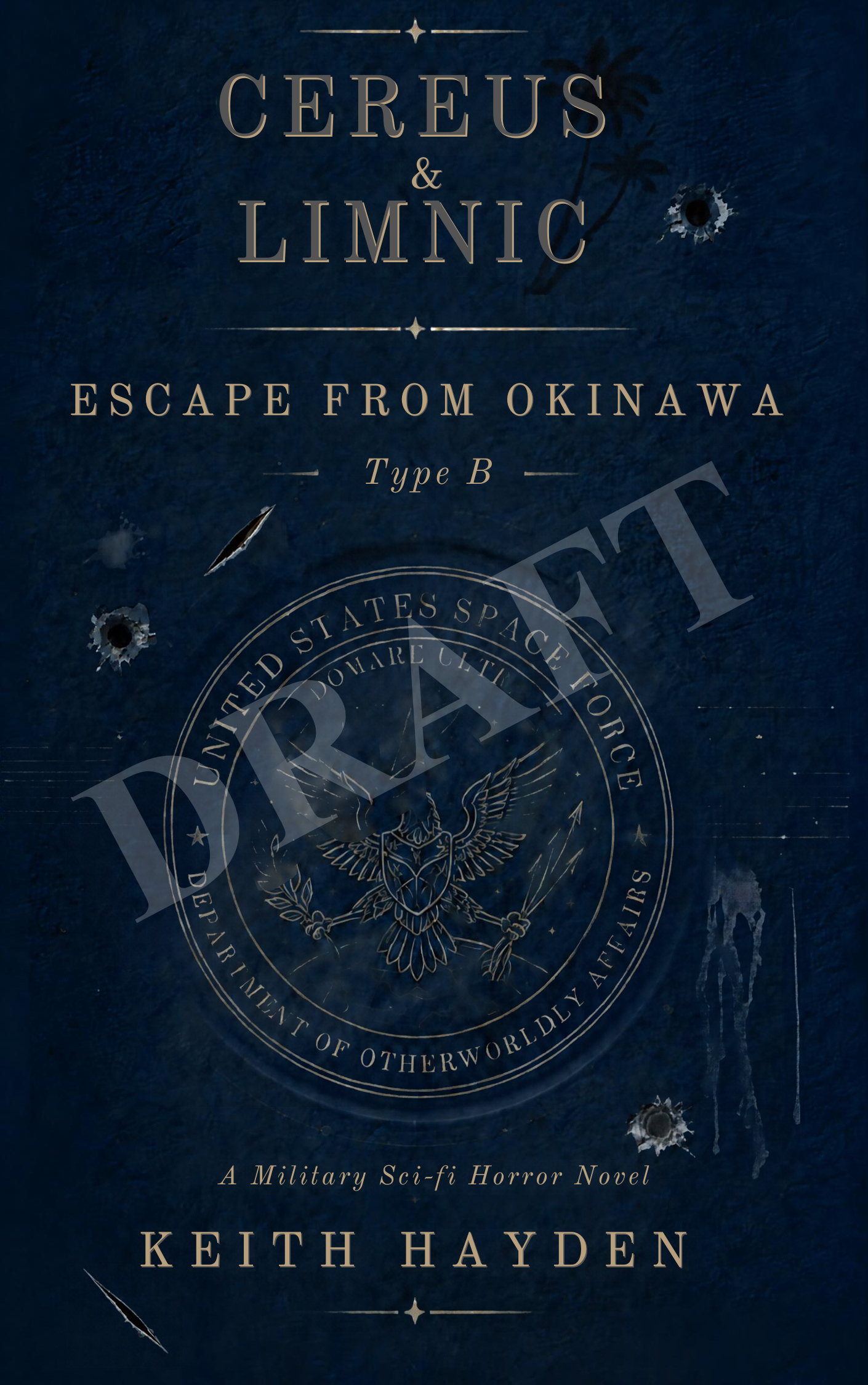
Cereus & Limnic: Escape From Okinawa Type B
Keith Hayden
Full Video (39 mins)
Video Text
I originally thought about titling this reflection All My Excuses.
I just got back from my second time at MCON, a military conference here in my area, and I have a lot on my mind about writing, publishing, and what it actually takes to stay on track toward my ultimate goal: becoming a writer who gets paid and is known primarily for his fiction.
If you're seriously trying to get paid for writing fiction, I want to ask you one question:
What part of your process are you ignoring, even though you know it’s true?
For the last sixty days, I’ve been leaning hard into a no shit audit of my own habits. Between finishing a coding bootcamp, revamping how I present myself online, and actually watching how people respond when I hand them a physical book, I’ve had to confront a few sobering truths about the modern creator landscape— and the excuses I’ve been making along the way.
1. Giving People One Anchor: Reclaiming the Craft
Prior to last month— September 2026— my mentality around calling myself "The Digital Novelist" was that I wanted to be known for integrating every domain I’ve studied and gained skills in. Art, music production, voice acting, publishing, and software development after finishing the Code Platoon coding bootcamp this summer.
The hard part about doing everything is that people need an anchor. They need one thing to start with when they meet you, and once they have that, you can introduce the rest.
My first move in rebranding myself wasn’t just saying I’m a novelist; it was putting undeniable proof out there that writing fiction is my main concern.
I tore down my standard author website setup. You know the one— where visitors have to sift through an entire collection of work: Here’s my store, my books, oh here's some short stories, services, and my About Me.
All that's still live, but I moved it to the backshop. Upfront is a single book visitors can explore. That was step one.
Step two was being bout it in my daily activity.
Since finishing Code Platoon a month and a half ago, I’ve worked on my novel every single day for 60 days straight.
Some days that means drafting a new chapter. On others it was planning a multi-chapter arc, fleshing out a new character, or spending a few days getting spun up on heavy research— like a whole marine biology arc I had to build out recently. Even if I don’t get actual prose down on a research day, the goal is keeping the habit unbroken.
After 60 straight days, I feel like a novelist.
I’ve already written and published three novels— this is my fourth— but right now, the craft is constantly alive in my head.
Compare that to what I used to do: grabbing 30 minutes or an hour here and there, working so discontinuously that it took weeks just to finish a single chapter draft. Looking back on that, I have to ask myself: How the hell do you ever expect to finish a whole fucking novel working like that?
It takes years that way. And it has taken years for this book. I got the idea for my upcoming military sci-fi horror novel back in 2022 while living in Okinawa.
I didn't get serious about it until 2024, blew past 2025 because I knew it was going to be a long, demanding book, and here we are near the end of 2026.
The way important projects do, this novel kept demanding more of me, and I had to give it the space it needed.
Right now, I’m eyeing a Summer 2027 release because I want everything ready at launch: eBook, print, audiobook, wide distribution, and a Japanese translation.
Doing all of that while still writing the damn book is brutal. Which brings me to the second part of the last six weeks.
2. Social Media Is Just "The Floor" (And Why I Refuse to Use AI Graphics)
The second part of my strategy over the last month and a half has been a social media revival.
I’ve been in the content trenches for nearly ten years.
I launched my website in 2017, uploaded my first YouTube video in 2018, and cut my teeth in the language-learning space around 2018–2019 when I was writing Tower of Babbling, answering questions on Quora and posting on Twitter.
From 2021 to 2023, I adapted my first novel, Cereus & Limnic, into an audio drama podcast. Back then, it would take me a full week to produce one song in Ableton, and I’d post screenshots of my DAW or videos of me recording a scene just to have something to show.
That podcast eventually hit nearly 40,000 downloads.
Here’s the truth about social media from the creator side: almost everything bad people say about it is true. It is often not fun, and it eats up a massive amount of time.
Worse, when I looked back at everything I posted between 2018 and 2025, I had to ask myself: How much of the content I was putting out was actually my writing?
The answer was: not much. I was convinced—rightfully so at the time—that text alone wouldn’t move the needle, and since I couldn’t draw and didn’t have an artist on retainer, I defaulted to putting myself on camera.
What I actually want to be known for is combining the compressed, concise format of modern storytelling with engineered, intentional literary sentences.
So over the last few weeks, my approach to social media has shifted. I’m using new AI workflows to speed up the backend friction, but I don't use AI-generated images.
It isn’t a moral stance; I just hate the aesthetic. Walking around MCON this weekend, it was the first time I saw AI-sourced graphics and typography everywhere.
To the average person who couldn't make graphics before, it makes total sense—it’s not even replacing a designer they would have hired, because they just wouldn't have had graphics at all.
But personally, I can’t stand the look.
It has this glossy, overly performative, sheened graphical style where you can immediately tell someone just accepted the status-quo output from ChatGPT or Gemini without doing anything creative.
Instead of glossy AI art or over-engineered viral hooks, my videos right now are just me working, showing my writing process, and talking about the book.
It still takes hours every day, and after a few weeks, the verdict is clear: in 2026, social media is simply the floor.
People expect you to have something there when they look you up, and my posts are doing their job of proving that I exist and that my primary purpose is writing fiction.
3. The 97% Reality: Dropping My Excuses About In-Person Sales
Social media creates awareness. Selling books is a completely different story.
In two days at MCON, I sold a copy of Gates of Okinawa on day one, and copies of Prompted Hearts and Grief Algorithm yesterday.
If I’m being completely honest with myself, probably 97% of the book sales I’ve made in 2026 have come from in-person interactions—book fairs, signings, and conferences.
If I’ve made sales online this year, I barely notice them. And unless you launch big on Amazon from the jump, it is notoriously hard to get the algorithm to push a backlist title when you haven't dropped a new book in a year.
Realizing that nearly all my sales happen face-to-face is sobering, because I barely do in-person events. I only went to MCON because it was right here in my area.
Why haven't I gone nuclear with a boots-on-the-ground book-selling campaign?
Part of it is logistical: gas is expensive, you have to drive around, make cold calls, and build a network from scratch.
But really, the whole thing was psychological.
I’ve been timid about pushing my work aggressively in person because my stuff doesn't fit neatly in a box. It’s weird. It’s out there. It combines different cultures, different languages, and— biggest of all— different worldviews.
I tell myself that a lot of people aren't down with that, don't understand it, and don't want to understand it.
All of that is just excuses.
Because here is what actually happens when I show up in person: I have the wow factor.
When I walk into a room, I’m a Black male fiction writer carrying a substantial, thick physical novel—still pristine in its original shrink-wrap—and you can tell immediately by holding it that real work went into it.
People don't see that every day.
There aren't a lot of Black male novelists walking around who seriously claim the title, tell you to look up their catalog right then and there, and have the book in hand ready to close the sale. It is rare, it is memorable, and I close sales in person because of it.
Until now, I haven't optimized for that at all.
Even when I went to local writing clubs or meetups after coming back to the States, I treated them as craft spaces or networking spots to talk technique with other writers.
And honestly, author spaces are terrible places to sell books—most of the people in casual writing groups aren't even finishing books or trying to make money from their writing, which is why I eventually stopped going to my old group.
If I want actual readers and long-term fans, social media is fine for awareness, but I have to get them in person.
4. Interrupting the Queue: The War for a Reader's Attention
It has never been a better time to be a creator, and it has never been more overwhelming.
Every platform wants to lock you into its ecosystem—Amazon emailing you to update your Kindle settings, IngramSpark, Spotify, YouTube, ACX. You’re juggling print, eBooks, single-narrator audiobooks in your own voice, AI audio options, sound effects, and video generation, all while trying to actually write the next book.
And even when you hand-sell a book to someone in person, you hit the next wall: getting them to actually read it.
Right now, I don't care about the $30 from a book sale for the money; I care about the chance to get a reader into the story. Because the way people operate today, they buy a book, say "Oh, I'll get to it later," and never open it.
Look at the mental landscape of the average reader in 2026. Some people are mentally booked out for years.
They have an entire TV series they’re committed to watching, a book series they have to reread because a movie adaptation is coming out and all their friends are talking about it, a spin-off show that sends them back into an old franchise, Halloween movie marathons this week, Christmas movies next month, football all weekend, plus an infinite feed of YouTube videos and AI-accelerated social content.
To get someone to read a book today, you have to interrupt their queue. You almost have to shove the fucking book into their hand, open it to page one, and say, Read.
Obviously you can't literally do that, which is why I make audiobooks available alongside the print editions.
Lately, I’ve even been thinking about borrowing a local space for an hour or two, passing out physical copies of the book just like we used to do in school, and reading Chapter One out loud together so people can follow along on the page. At the end of the session: Want to keep going? It’s $30, take the copy in your hand home.
You have to physically push people past the friction of starting.
5. Kill the Gremlins and Write Your Damn Book
So where does that leave you and your goals?
Maybe you're exclusively online because it feels safer, getting lost in a sea of infinite content when you should be building an in-person strategy.
Or maybe you need to look hard at how you've spent the last six months and ask yourself: Are you actually making the art?
I see a massive trap on "Writing YouTube" where self-proclaimed failed writers start a channel, find a niche, and suddenly spend all their time talking about writing instead of writing. You get "9 Tips to Write a Bestselling Novel" from a guy who published one book ten years ago.
Once audience-building starts working, the draw is too strong to resist, and you double down on being a content creator instead of a novelist.
I know that rabbit hole because I’ve fallen down it myself. Between late 2020 (when I finished my first novel) and the end of 2023, I went two full years dabbling in drafts and short stories without finishing and releasing anything new.
I had to look in the mirror and ask: Am I a fraud calling myself a novelist when nobody can read anything new from me?
Or maybe your hang-up is even earlier than that.
A guy came up to me at the conference and said how cool it was that I’d actually written multiple books, put them out, and was out there selling them.
Selling books is way down the line. Day one of writing fiction is being able to stand the sound of your own inner voice manifesting on the page.
A lot of people say they want to write, but they aren't serious—they’re terrified of having an opinion or a vision on the page that diverges from the popular zeitgeist.
They write a paragraph, get flustered by what they see, and start revising endlessly to prevent an imaginary internet mob from coming after them, or to please some faceless critic sitting in the shadows of their mind.
Then they look online, see people complaining about AI, and let everything discourage them.
If you let those gremlins in your head control your pen, you will never finish a book—or if you do, you won't be proud of it, because you'll know fear overshadowed what you actually wanted to say.
Look at the stories that dominate culture today: people literally watch grown adults fly around in tights and underwear on screen. At one point, superhero stories were weird, too.
Yesterday at the conference, a speaker from Disney told the story of Walt Disney losing the rights to Oswald the Lucky Rabbit.
He had his IP stolen out from under him, got on a train ride home, sent a telegram to his brother saying everything was going to be okay, and on that train ride, came up with Mickey Mouse.
Obviously, creating a century-old, multi-billion-dollar storytelling machine is a one-in-a-million shot.
Millions of creators have taken that same train ride home without building an empire.
But the moral of the story is still true: even if you feel like you’ve lost momentum, or you’re starting from zero, if you are a writer, you still have your imagination.
You can always come up with something new—and because of the setbacks you’ve survived, it’ll probably be even better than what you had before.
Keep writing, no matter what.
What part of your creative process have you been avoiding lately?
Drop your thoughts in the comments.
If you want to follow my journey, subscribe to the Novel Revealed podcast and visit keithhayden.net for more stories and updates on my upcoming military sci-fi horror novel, Cereus & Limnic: Escape From Okinawa Type B.