
"Sharla showed little surprise in seeing them. But there was some joy in her expression, a crack of light under a door’s equivalent."
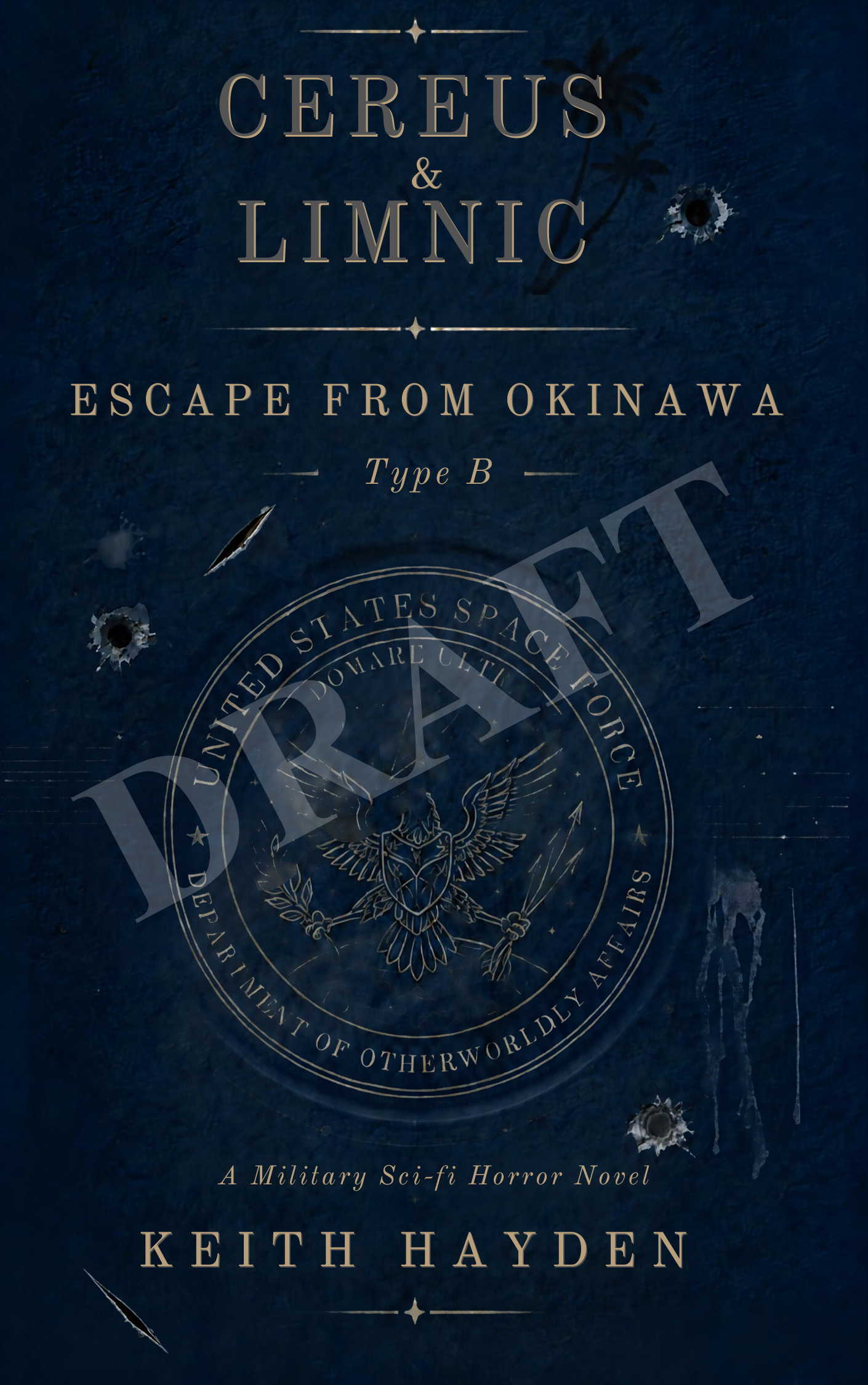
Cereus & Limnic: Escape From Okinawa Type B
Keith Hayden
I've got nearly two horror novels written. And it occurred to me that I've learned a lot about how to write it well in the process.
Here you'll find my horror, samples from upcoming work and why I write it.
I wanted to dive deep into exactly how and why I started writing in a genre I never planned on tackling: horror.
I am not the biggest consumer of horror media. I’ve read a few Stephen King novels and House of Leaves, but I haven't read the massive classics like It or The Stand.
My storytelling doesn't come from reading other people's scary stories; it comes from real life.
Before writing fiction, I was a military investigator— specifically, a special agent with the Air Force Office of Special Investigations (AFOSI).
In that job, I investigated crimes, some of them incredibly heinous and horrific. I talked to actual victims and actual perpetrators, giving me a front-row seat to the extreme edges of the human condition.
When you combine that with a natural tendency to always ask "what if?" and a heavy diet of Dan Carlin’s Hardcore History, you end up writing stories about how people fundamentally change when confronted with things outside of their immediate understanding.
The External Trap: Lessons from Gates of Okinawa
I started writing my first horror novel, Gates of Okinawa, in the spring of 2024. As I was writing it, I kept thinking, “It’s not scary enough,” so I actively tried to punch it up.
It featured a teacher and her students fighting highly visual, colorful Japanese demons (yōkai) to save Okinawa.
When I finally finished the 6-to-7-month process of writing the manuscript, I handed it to my wife.
Now she's not a horror fan at all—she gets scared easily by suspense and gore. When she finished she told me: "It’s not that scary.". Not what you wanna hear after spending half a year writing what you wanted to be a scary story.
I had failed to write a pure horror novel.
It ended up being more of a supernatural adventure story with horror moments. That experience taught me a massive lesson:
External horror—the monster under the bed or the demon from hell—typically doesn't make a great horror story on its own.
You can't rely solely on scary images, visceral body horror, or a big bad monster. You need suspense, the unknown, and isolation to make it really hit.
The Engine of Dread: The Psychological Void
My current project, Escape from Okinawa, is a military sci-fi horror novel, and it approaches fear very differently.
Yes, there is some sick, visceral body horror. There is a scene where a woman's sculptured belly ripples open, spilling out a rancid, highly vascular membrane as she transforms into a "Crown of thorns in human form."
But those scenes are just the flash bang to stun you. The actual spirit of the horror is the psychological void.
To write good horror, you have to get at what scares you. For me, it's not a kinetic, external threat.
It's incomplete information, unexplained phenomena, and small tilts in reality—like knowing exactly where you put an object down, only to find it gone without explanation.
I am playing with this heavily in Escape from Okinawa by using an epistolary format. The chapters are called "exhibits," written as fragmented investigative accounts and reports, drawing directly on my time writing reports as an AFOSI agent.
This format locks the reader entirely inside a restricted point of view. Just like in the Resident Evil games, where the story is told through scattered logs and journals, the dread comes from knowing you aren't getting the whole picture.
The Myth of the Spooked Writer
There's a myth about how it feels to write horror, that guys like Stephen King sit at their keyboards terrified of their own creations.
On occasion, the tension of writing in this genre does get to me, but most of the time, I don’t feel scared at all.
My focus is on working within strict limitations. The fear is generated by isolating the character and the reader, forcing them to navigate a world where what isn't said on the page is far more important than what is.
Horror is a pure extension of the human condition.
Every single day, you deal with internal threats, intrusive thoughts, and past traumas. Yet, you still have to function in the real world: you have to make breakfast, go to work, and take care of family commitments.
Writing horror is just taking those internal, everyday threats, dialing them up to twelve, and making them explicit through words.
You see this done brilliantly in works by Japanese authors I've encountered.
Kyōgoku Natsuhiko’s massive 1,400-page novel The Summer of the Ubume frames horror around the cultural friction between rapid post-WWII modernization and ancient secrets.
Junji Ito’s Uzumaki derives its terror not from the monster itself, but from the characters' odd compulsion to destroy themselves by engaging with it. Horror, ultimately, is about transformation.
A Shorthand for Writers
If you are struggling to write in this genre, I can leave you with two pieces of advice from this project:
- Start with a disturbing foundation: Base your story on a disturbing image, topic, or a completely twisted perspective on how a character views the world.
- Use the label to your advantage: If you want to write a horror story, call it a horror story. Priming your audience is half the battle. If you walk into a sunny house on a hill and someone tells you, "There are fucking ghosts living here," you will unconsciously start listening for weird creeks and anomalies. The label primes the reader to look for the unsettling.
If you want to read some of these unreleased exhibits and see this psychological void in action, you can check out the raw progress of Escape from Okinawa on my website and social media channels.
Have a safe and happy Halloween.
Read the novel: