
There was no rifle to defend myself, only instinct.
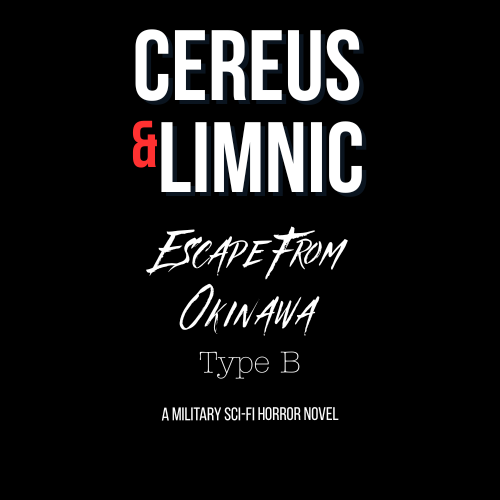
Cereus & Limnic: Escape From Okinawa Type B
Keith Hayden
Today's writing session took way too long and wasn't satisfying.
When you pick a bad chapter format, commit. (20 secs)
Full podcast episode (10 mins)
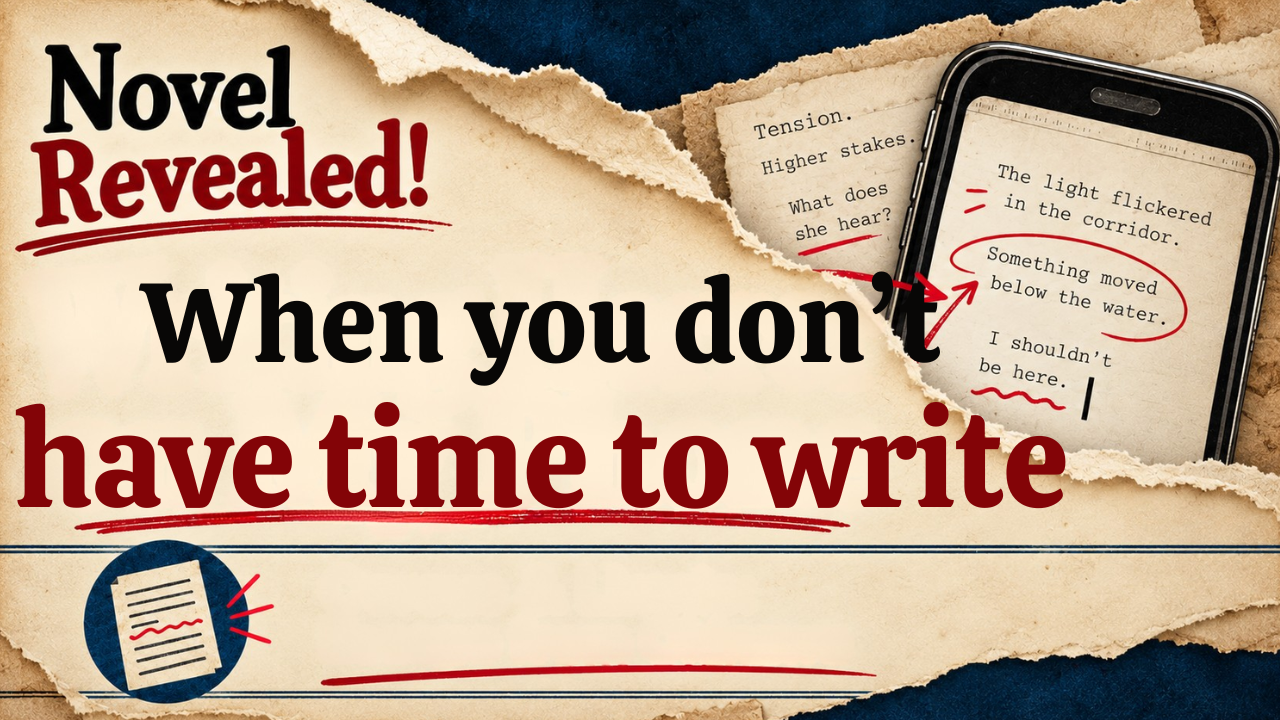
What to Do When You Don't Have Time to Write
Prefer to watch or listen? Catch the full episode of the Novel Revealed podcast on YouTube:http://www.youtube.com/watch?v=WgWx-wA_G24
If you write fiction, you already know the twin enemies of a finished manuscript: distraction and a lack of time.
Most of us aren't full-time novelists. We have demanding day jobs, kids, families, and responsibilities that don't care about our word counts [00:21]. Recently, a viewer left a comment on my YouTube channel asking how to find time to write when life leaves you with nothing left in the tank.
Before I answer that, though, I have to confess how I almost torpedoed my own writing session today.
The Trap of "Productive" Procrastination
My magic writing window is between 4:00 and 6:00 a.m. That two-hour block is when my brain is sharp, the house is quiet, and I legitimately get my best work done [01:44].
Today, I wasted almost that entire window building a custom on-screen word counter [00:54].
Because I've been recording and sharing my live writing sessions lately, I wanted a way to level up the visual experience—a live meter that tracks my progress as I draft. Even though I've said before that word count isn't everything, it's still satisfying to watch a visual metric tick upward while you work.
The problem? That "simple" tool took forever to build [01:44]. With another commitment waiting for me in the middle of the day, my prime morning block evaporated before I even opened my manuscript.
As writers, we are masters at inventing productive-sounding excuses to avoid the actual work [05:20]:
- "I just need to tweak this tracking tool first."
- "I need to go research one more historical detail."
- "Let me reorganize my project folders before I start."
It feels like work, so we let ourselves off the hook. In reality, it's just procrastination wearing a nicer shirt.
When Form Fights Flow: Drafting a Battle Scene as a Sestina
As if losing my morning block wasn't bad enough, I decided to make things even harder on myself by writing today's chapter in a format I had never tried before: a sestina [02:23].
Dating back to the 13th century, a sestina is a strict 39-line poetic structure composed of six stanzas of six lines each, followed by a three-line envoi. Instead of rhyming, the form requires you to repeat the same six end-words in a specific, rotating mathematical pattern across every stanza.
The scene I was drafting for my military sci-fi horror novel, Cereus & Limnic: Escape From Okinawa Type B, follows my protagonist, Ryu, as he's caught in the middle of a brutal firefight on a beach [04:00]. He isn't storming the beach like a hero—he's trapped between warring factions, forced to fight and kill just to make it across the sand alive.
I thought the rigid, inescapable cycle of a sestina would be a cool way to mirror the claustrophobia of combat.
Halfway through, I realized I hated it [03:04].
I'm a long-form writer by nature. I like having the room to expand an idea, contract it, and let the narrative breathe. Having to stop after every line to check my structural map—"Wait, what was my A-word? Which word goes at the end of the D-line?"—completely shattered my creative flow [04:00].
Because I was already distracted, pressed for time, and fighting the format, a 500-word chapter that I already knew inside and out took me two and a half hours to grind through [03:04].
The silver lining? It's done, and the poetic delivery actually gives the violence a stark, haunting edge [04:53]. But it was a hard reminder that distractions and self-imposed friction will drag you away from your manuscript if you let them.
Writing When Your Day Job Leaves You Depleted
That brings me back to the question from my YouTube comments: How do you write when you simply don't have the time or energy?
A few years ago, while writing my first novel during COVID, I was in the middle of a teacher-training program [05:45]. I had finished the classroom theory portion and was student teaching—shadowing full-time teachers and working live in the classroom with kids all day.
If you work a job that is psychologically or physically demanding, you know what happens when you finally get home. The "echo of the day" is still clinging to you [06:24]. By the time you sit down in your chair to write, you are completely depleted.
Back then, I realized that if I waited until I felt rested and inspired at my desk, the book would never get written. So I started forcing myself to draft on my phone during the day [06:24].
The Power of Micro-Moments
When you can't find a two-hour block of uninterrupted silence, you have to build your book out of micro-moments [07:01].
Here is how that looks in practice:
- Claim the edges of your day. When I was going through an intensive coding bootcamp this past summer, my days were packed with classes and coursework. So I committed to waking up an hour early every morning just to work on my novel [07:01]. Did I hit that mark every single day? No. But setting that intention kept the manuscript moving. If you're not a morning person, claim the last 30 minutes of the night after everyone else goes to bed [07:34].
- Use the Five-Minute Rule. At one point in my life, I built my drafts through five-minute sessions [07:34]. No matter how exhausted or busy you are, you can write one sentence in five minutes. Over weeks and months, single sentences stack into paragraphs, chapters, and eventually a finished book.
- Hijack your idle time. Very few jobs are genuinely back-to-back for eight hours straight without a single pause [08:10]. You have a commute, a 15-minute gap between meetings, or a lunch break. Give 15 or 30 minutes of your lunch hour to your novel before you eat. Hell, write on the toilet—what else are you doing in there besides scrolling on your phone anyway? Pull up your notes app and get three sentences down [08:10].
Stop Waiting to "Find" Time—Make It
"I don't have time to write" is the biggest excuse we tell ourselves as creatives [08:58]. We point to our jobs, our kids, our spouses, and our obligations as proof that our hands are tied.
Whenever I hear someone say they don't have time to write, I know the truth: they aren't making the time [08:58]. Either they are letting everything else dictate their schedule, or they are unconsciously bleeding away their free margins on doomscrolling and passive habits.
Breaking out of that unconscious cycle is hard [08:58]. Calling yourself out is uncomfortable.
But if you are serious about finishing your story—and especially if you want to publish and sell your fiction—you have to guard those five-minute pockets of time [09:37]. Showing up for one sentence a day does more than just add to your word count; it keeps your head inside the world of your story so you aren't constantly losing momentum to massive gaps between sessions.
I'm currently in the final stretch of my military sci-fi horror novel, Cereus & Limnic: Escape From Okinawa Type B, slated for release in early 2027 [10:01]. If you want to follow the behind-the-scenes process, subscribe to the Novel Revealed podcast on YouTube.
AI Analysis: Cereus & Limnic: Escape From Okinawa | Exhibit 062 (41 mins)
Read the novel early: